
Easy Openings for White: Why the Italian Game is Your New Best Friend
Why Easy Openings for White Can Transform Your Game
Easy openings for white don’t require you to memorize dozens of moves. Here are the best beginner-friendly options to start with:
- Italian Game (1.e4 e5 2.Nf3 Nc6 3.Bc4) — simple development, clear plans, immediate pressure
- Scotch Game (1.e4 e5 2.Nf3 Nc6 3.d4) — opens the center fast, frees your pieces quickly
- London System (1.d4 + Bf4, Nf3, e3) — solid structure, works against almost anything Black plays
- Queen’s Gambit (1.d4 d5 2.c4) — classical and reliable, great for positional players
- Alapin Sicilian (1.e4 c5 2.c3) — a simple answer to Black’s sharpest response
Learning the opening can feel overwhelming. There are hundreds of named openings, thousands of variations, and it seems like every opponent does something different.
But here’s the truth: you don’t need to know everything. You just need a few reliable weapons and a solid grasp of the principles behind them.
Bobby Fischer famously called 1.e4 “best by test” — and for beginners, that first pawn push is still one of the smartest ways to get a comfortable, active game right from move one.
The openings in this list were chosen for one reason: they work without making you memorize a library of theory. They reward good habits — controlling the center, developing your pieces, and keeping your king safe — over rote memorization.
Whether you prefer sharp tactical battles or calm positional play, there’s a simple, effective option here for you.
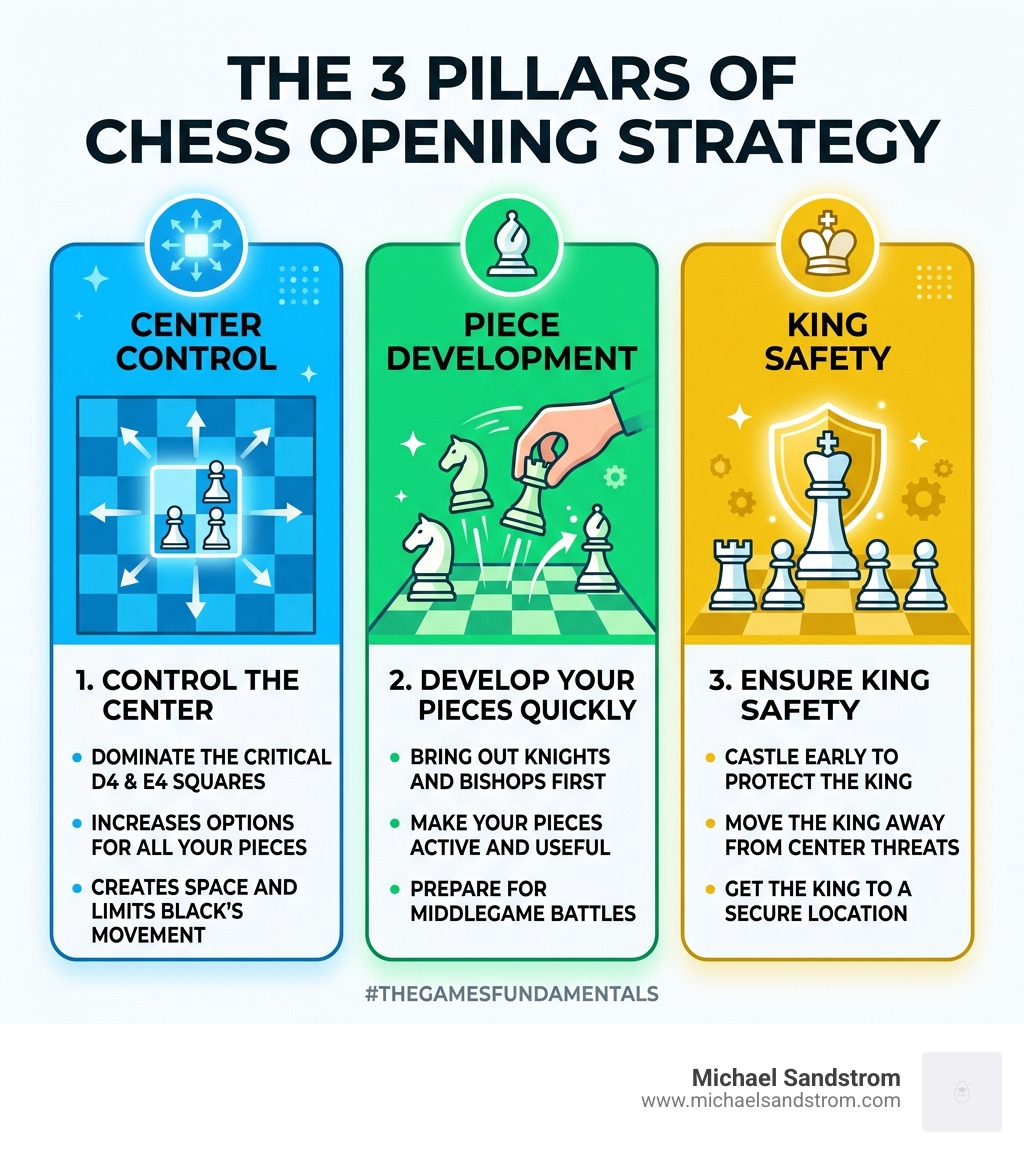
Core Principles of Easy Openings for White
Before we dive into specific move orders, we need to talk about the “why” behind the moves. As we head into April 2026, the chess world is faster than ever thanks to online blitz and bullet. However, the fundamentals of a good opening haven’t changed since the 1500s.
When we look for easy openings for white, we are looking for moves that satisfy the three pillars of opening strategy: center control, rapid development, and king safety. If an opening makes you move the same piece three times or leaves your king in the middle of the board, it isn’t “easy”—it’s a liability.
1.e4 vs. 1.d4: Which is for you?
Most beginners start with one of these two moves. While both are excellent (and played by grandmasters worldwide), they lead to very different types of games.
| Characteristic | 1.e4 (King’s Pawn) | 1.d4 (Queen’s Pawn) |
|---|---|---|
| Game Style | Tactical, open, and aggressive | Positional, closed, and strategic |
| Piece Mobility | Diagonals for Queen and Bishop open immediately | Solid pawn structure, slower development |
| Theory Load | High (many sharp responses like the Sicilian) | Lower (often system-based) |
| Beginner Friendliness | Excellent for learning tactics | Excellent for learning structure |
The Golden Rules of the Opening
Regardless of which move you choose, we always recommend following these five basic principles:
- Control the Center: Use your pawns (e4 or d4) to claim the middle of the board.
- Knights Before Bishops: Generally, knights belong on f3 and c3, where they control the center. They are easier to place than bishops.
- Don’t Move the Same Piece Twice: In the opening, every move should bring a new “soldier” into the battle.
- Castle Early: Your king is vulnerable in the center. Get him to safety and connect your rooks.
- Avoid Early Queen Moves: Bringing the queen out too soon makes her a target for Black’s smaller pieces.
Following these patterns isn’t just about winning games; it’s about training your brain. Scientific research on the cognitive benefits of learning chess patterns shows that recognizing these structures improves memory and problem-solving skills, which is why we emphasize them in our coaching.
The Italian Game: The Gold Standard for Beginners
If you asked us to name the single best easy opening for white, we would point to the Italian Game every time. It begins with the moves 1.e4 e5 2.Nf3 Nc6 3.Bc4.
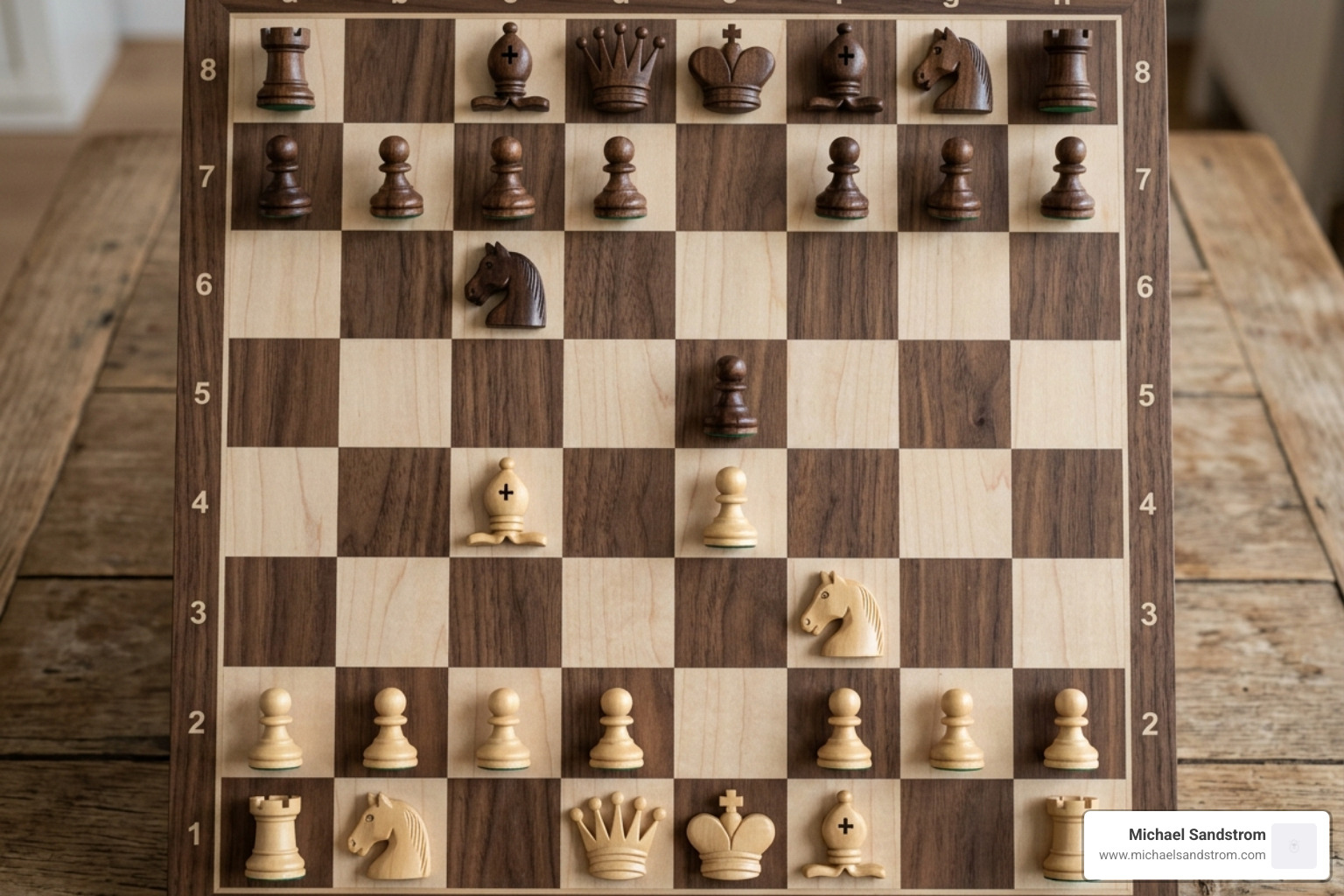
This opening is a masterpiece of efficiency. In just three moves, you have:
- Controlled the center with a pawn.
- Developed a knight to its best square.
- Developed a bishop to an aggressive post.
- Prepared to castle kingside.
The Power of the f7-Pawn
The move 3.Bc4 is the heart of the Italian Game. The bishop points directly at Black’s f7-pawn. Why is that important? Because in the starting position, f7 is the weakest point in Black’s camp—it is only defended by the King. By putting immediate pressure here, you force Black to be careful from the very beginning.
Variations: From Quiet to Explosive
The Italian Game is flexible. You can play the Giuoco Piano (the “Quiet Game”), where you develop slowly with d3 and c3, building a “house” for your pieces. Or, if you’re feeling spicy, you can try the Evans Gambit (4.b4), sacrificing a pawn to distract Black’s bishop and take over the center.
Even modern grandmasters like Magnus Carlsen use the Italian Game to avoid the heavy, drawish theory of the Ruy Lopez. It’s an opening that grows with you—from your first game to your thousandth.
Why the Italian Game is an easy opening for white
The beauty of the Italian is that your pieces have “natural” squares. You don’t have to wonder where your knight goes; it goes to f3. You don’t have to wonder where your bishop goes; it goes to c4.
We often tell our students that the Italian Game is about “piece harmony.” Everything works together. You castle on move four or five, your rooks are ready to move to the center, and your plans are clear. You aren’t fighting your own pieces for space.
If you are just starting out, understanding these basics is more important than memorizing 20 moves of a computer-generated line. For those looking to dive deeper into these fundamentals, you can find More info about chess opening basics on our main site.
Top Alternatives: Scotch Game and London System
While the Italian is fantastic, it isn’t the only way to play. Some players find the Italian a bit too “common” and want something that forces the issue.
The Scotch Game (1.e4 e5 2.Nf3 Nc6 3.d4)
The Scotch Game is the ultimate “space grabber.” By playing 3.d4, you immediately challenge Black’s center pawn. After the trade (3…exd4 4.Nxd4), the center is wide open.
This is a great easy opening for white because:
- It frees your pieces: Your bishops have open diagonals immediately.
- It’s hard to counter: Weak players often struggle when the center disappears so early.
- History of Success: It was a favorite of Garry Kasparov, who used it to revive interest in the opening at the highest levels.
The London System: The “Opening House”
If you prefer 1.d4, the London System is your best friend. It is often called a “system” because you can play the same moves regardless of what Black does.
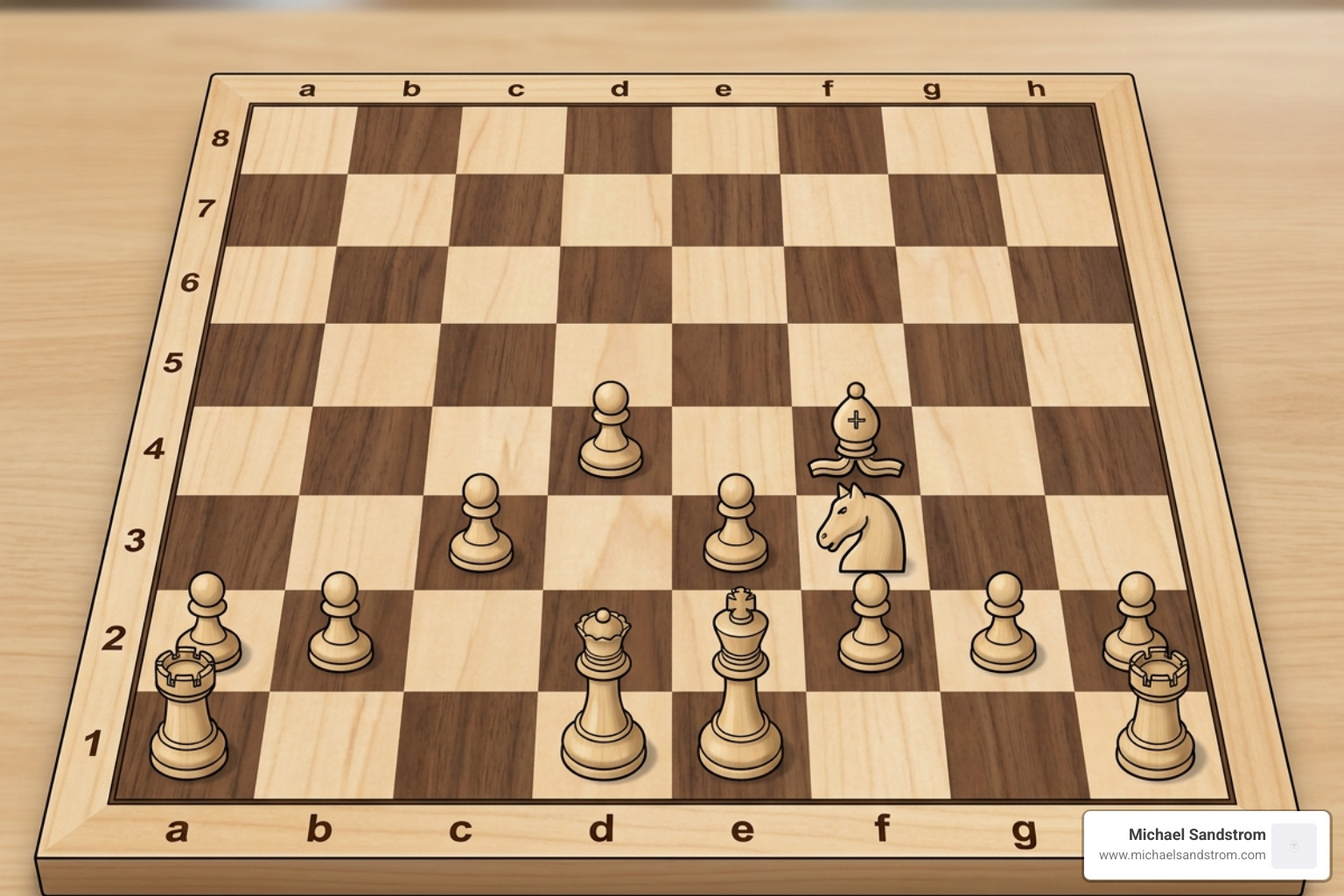
The setup is simple:
- Pawn to d4
- Knight to f3
- Bishop to f4 (The “London Bishop”)
- Pawn to e3
- Pawn to c3
- Bishop to d3 or e2
- Knight to d2
By the time you reach move seven, you have built a rock-solid pyramid of pawns. This is incredibly time-saving in blitz and bullet games because you can play the first ten moves in seconds. It’s a “low-theory” haven for busy players who have jobs and families and can’t spend five hours a day studying the latest grandmaster novelties.
Mastering the London System as an easy opening for white
The London System is often teased for being “boring,” but don’t let that fool you. While the structure is solid, it hides a venomous kingside attack. Once your “house” is built, you can often swing your knight to e5 and launch your h-pawn up the board to crack open the enemy king.
It’s an easy opening for white because it focuses on a formation rather than a sequence. If Black plays 1…d5, you play the London. If Black plays 1…Nf6, you play the London. This flexibility reduces the amount of study time you need by about 80%.
For players who want to move beyond just surviving the opening and start winning with these structures, we offer More info about mastering white openings through our step-by-step mastery courses.
The Colle-Zukertort Variation
A close cousin to the London is the Colle-Zukertort System. Instead of putting the bishop on f4, you keep it on c1 for a moment, develop your other bishop to d3, and then fianchetto your queen’s bishop to b2. This setup is famous for producing “Greek Gift” sacrifices on h7, leading to spectacular checkmates. It’s particularly effective for players under 2000 ELO who want a solid base with high attacking potential.
Handling Black’s Defenses Without Heavy Theory
The biggest fear for a beginner is playing 1.e4 and seeing Black respond with something other than 1…e5. What do you do against the Sicilian, the French, or the Caro-Kann?
The secret to keeping these easy openings for white is to choose “Exchange” or “Simple” variations.
The Alapin Sicilian (1.e4 c5 2.c3)
The Sicilian Defense (1…c5) is Black’s most popular and highest-scoring response. It’s incredibly complex—unless you play the Alapin. By playing 2.c3, you prepare to play d4 and create a perfect two-pawn center. It bypasses the mountains of theory in the “Open Sicilian” and forces Black into a game they likely haven’t studied as much as you have.
The French and Caro-Kann Exchange Variations
- French Defense (1.e4 e6 2.d4 d5 3.exd5): Instead of dealing with the cramped, complicated positions of the Advance variation, just take the pawn! The Exchange variation opens the board, makes development easy, and leads to very clear play.
- Caro-Kann Defense (1.e4 c6 2.d4 d5 3.exd5): Similar to the French, taking on d5 simplifies the game. However, if you want to be more aggressive, the Advance Variation (3.e5) is statistically very strong, with White winning about 43% of games at the master level. It cramps Black’s style and makes it hard for them to develop their kingside.
Dealing with the “Offbeat” Moves
Against the Scandinavian Defense (1.e4 d5), simply take the pawn (2.exd5). Against the Pirc Defense or the Modern, just follow your principles: take the center with d4 and e4, develop your knights, and castle. Don’t let the weird pawn moves scare you—if you control the center, you have the advantage.
Frequently Asked Questions about White Openings
How many openings should a beginner learn?
We recommend a “Rule of One.” Learn one opening for White (like the Italian or London) and one response for each of Black’s major defenses.
Building a repertoire is about depth, not breadth. It is much better to know the first 10 moves of the Italian Game perfectly than to know the first 3 moves of twenty different openings. As you grow, you can expand, but for now, focus on mastering the principles within your chosen few.
Is the King’s Gambit suitable for new players in 2026?
The King’s Gambit (1.e4 e5 2.f4) is a wild, high-risk opening. While it was the favorite of the 1800s, it’s rarely seen at the master level today because it’s objectively risky.
However, for a beginner, it can be a fantastic “tactical gym.” It forces you to calculate and attack. If you enjoy aggressive play and don’t mind losing a few games to learn how to attack, give it a try! But if you want something reliable and solid, stick to the Italian or Scotch.
How do I develop my rooks quickly?
This is a common question. Rooks are the most powerful pieces after the Queen, but they often get stuck in the corners. The secret to freeing them is a three-step process:
- Castle: This immediately moves one rook toward the center.
- Develop all minor pieces: Once your knights and bishops are off the back rank, your rooks are “connected.”
- Find open files: Rooks love files with no pawns. Move them to the d-file or e-file where they can exert pressure on the enemy camp.
Conclusion
At the end of the day, the best easy openings for white are the ones that make you feel confident. Whether you choose the classical beauty of the Italian Game, the space-grabbing Scotch, or the unshakeable London System, the goal is the same: to reach a playable middlegame where you aren’t already losing.
At Michael Sandstrom, we believe in strategy mastery through step-by-step coaching. Chess shouldn’t be a game of memorizing lines you don’t understand; it should be a game of purposeful moves and piece coordination. By sticking to these easy-to-learn openings, you free up your mental energy to focus on what really matters—winning the game.
Ready to take your opening play to the next level?
